Your dashboard lights up like a Christmas tree for two seconds every time you start the car, then most of the lights go out. That bulb check is normal. The problem is knowing what to do when one of those lights stays on while you are driving, because some of them mean “get it looked at this month” and a couple of them mean “pull over right now before you turn a $200 repair into a $6,000 engine.” Most drivers cannot tell the difference, and that guesswork is expensive in both directions: people panic over harmless amber lights and keep driving on red ones that are quietly destroying the engine.
The good news is that carmakers actually built a simple color code into the system. Once you learn it, you can read your dashboard like a traffic light. This guide walks through what the colors mean, then goes symbol by symbol through the lights you are most likely to see, what causes them, and roughly what they cost to sort out in the US.
The color code: red, amber, green, blue
Almost every warning light follows a color logic borrowed straight from traffic signals.
- Red means stop or serious danger. A red light is the car telling you something could hurt you or cause major damage right now. Most red lights mean you should slow down, find a safe spot, and shut the engine off. Oil pressure, coolant temperature, brake system, and charging faults live here.
- Amber or yellow means caution: a system needs attention soon, but you can usually keep driving carefully. The check engine light, ABS, tire pressure, and traction control warnings are amber. Get them diagnosed, but you do not have to abandon the car on the shoulder.
- Green or blue is just information. Your headlights are on, cruise control is active, the high beams are lit. Nothing is wrong.
If you remember only one thing from this article, make it this: a red light means stop and investigate, an amber light means diagnose soon, and green or blue means relax. Everything below is detail on top of that rule.
Red lights: stop and check
Oil pressure (the oil can / genie lamp symbol). This is the scariest light on the dash and the one people most often ignore because “the oil is probably fine.” If this red light comes on while driving, your engine may be losing oil pressure, and an engine running without oil pressure can seize in minutes. Pull over safely, shut it off, and check the oil level. Do not keep driving to “get home.” A tow costs $100 to $200. A seized engine costs $4,000 to $8,000. We cover this one in detail in the oil pressure warning light guide.
Coolant temperature (thermometer in waves). A red temperature light or a gauge in the red zone means the engine is overheating. Continuing to drive can warp the cylinder head or blow the head gasket. Turn off the AC, turn the heater to full hot to pull heat out of the engine, and pull over. Never open the radiator cap on a hot engine. See cooling system problems and air locks and blown head gasket symptoms for what usually causes it.
Charging / battery (red battery box). This is not “your battery is low.” It means the charging system, usually the alternator or its belt, has stopped charging. The car is now running off the battery alone and will die when it drains, often within 20 to 40 minutes. Turn off everything you can (radio, AC, heated seats) and head somewhere you can stop. Alternator replacement runs $400 to $900. Our car battery guide explains how to tell a battery problem from a charging problem.
Brake system (red circle with an exclamation mark, or the word BRAKE). First check the obvious: is the parking brake fully released? If it is and the light stays on, you may be low on brake fluid or have a hydraulic fault. Low fluid can mean worn pads or a leak, and a leak means your brakes could fail. Test the pedal gently at low speed; if it feels soft or goes to the floor, stop driving and get a tow.
Airbag / SRS. A red or amber airbag light means the supplemental restraint system has a fault and your airbags may not deploy in a crash. The car drives fine, but you are unprotected. It is also a classic used-car red flag, which we come back to below.
Amber lights: diagnose soon
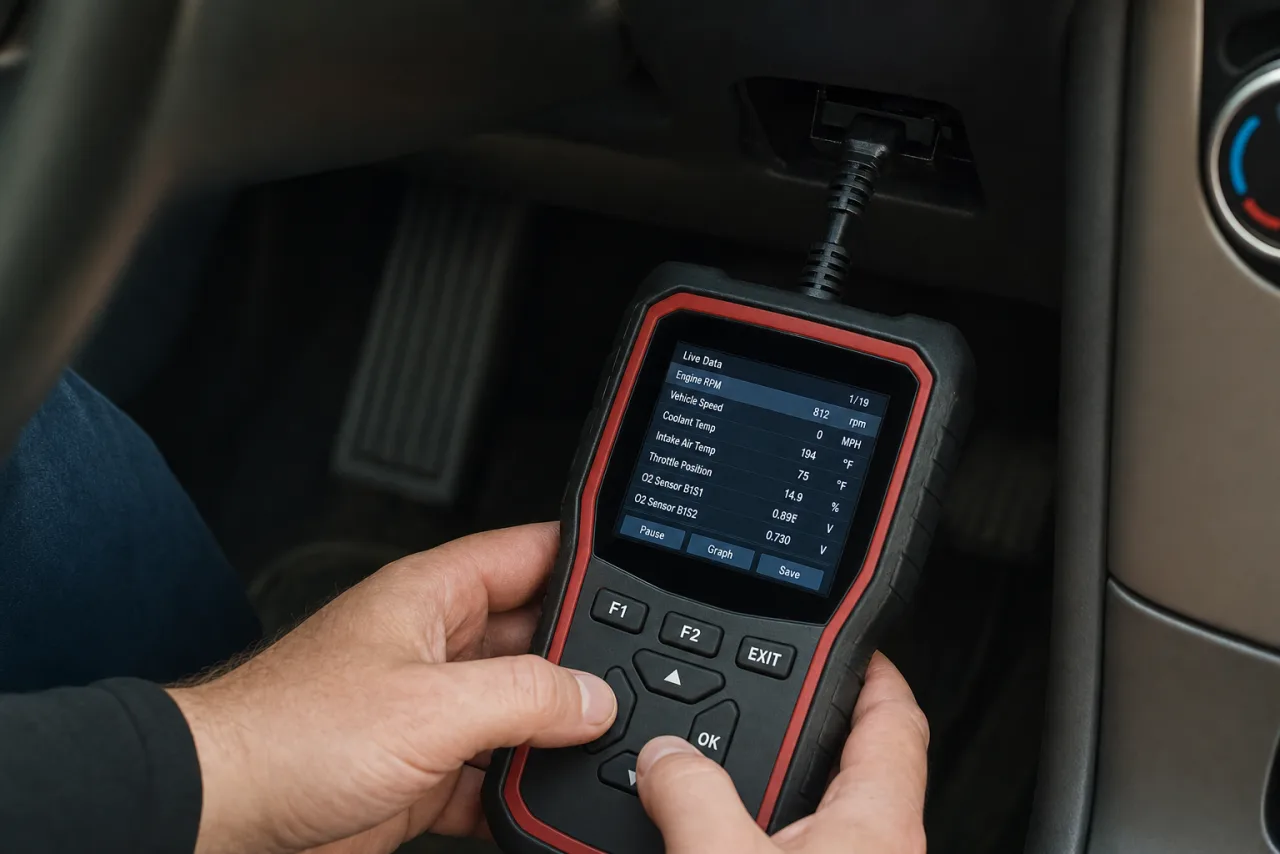
Check engine light (engine block outline). The most misunderstood light of all. Steady amber means a fault was stored but nothing is being destroyed right now, so drive gently and get it scanned. A flashing check engine light is different and more serious: it means an active misfire that can wreck your catalytic converter, so ease off and get it looked at fast. The full breakdown is in check engine light: what it means, and a $20 scanner will tell you the exact code, as covered in the OBD2 scanner guide.
ABS. The anti-lock braking system has a fault, usually a wheel speed sensor ($100 to $300). Your normal brakes still work, but the anti-lock function may not, so leave extra stopping distance in the rain. Not an emergency, but do not ignore it.
Tire pressure (TPMS, a cross-section of a tire with an exclamation mark). One or more tires is significantly low, or a sensor has failed. Check and inflate your tires. If it comes on in cold weather it is often just temperature dropping the pressure. A slow leak, though, needs a plug or patch ($20 to $40).
Traction control / ESP / stability control (a car with squiggly skid lines). If it flashes briefly while driving on a slick road, that is the system working, which is normal. If it stays on solid, the system is disabled by a fault, often the same wheel sensor that triggers ABS.
Glow plug (curled wire, diesels only). On a diesel this lights while the glow plugs warm up; wait for it to go out before starting. If it stays on or flashes after starting, there is a fault in the preheat system or engine management.
DPF / particulate filter (dotted exhaust box, diesels). This means the diesel particulate filter is getting clogged and needs a regeneration, usually a longer highway drive to burn off the soot. Ignore it and you risk an expensive blocked filter. See clogged DPF symptoms and cost.
Power steering (steering wheel with an exclamation mark). Steering may become heavy. On modern electric systems it can be a sensor or a fuse; on older hydraulic systems, check the fluid. More in power steering fluid and failure symptoms.
Green and blue: information only
These are not warnings at all. Green usually means a system is on and working: headlights, turn signals, cruise control, eco mode. Blue almost always means your high-beam headlights are on, so dip them for oncoming traffic. If a green light is blinking, it is usually just a turn signal or cruise indicator doing its job.
What warning lights mean when buying a used car
Here is where this becomes money. A dashboard full of lit warnings during a test drive is an obvious walk-away. The trickier trap is the opposite: a dashboard that looks perfectly clean because someone made it clean.
Two things to watch for. First, that two-second bulb check at startup. When you turn the key to “on” before cranking, every warning light should illuminate briefly, including the airbag and check engine lights. If a specific light never comes on during that check, a previous owner may have removed the bulb or disabled it to hide a fault. A missing airbag light in particular can hide a car that was in a crash with deployed airbags that were never properly replaced. Second, a check engine light that was cleared right before your visit will be off, but an OBD2 scan will show most emissions readiness monitors as “not ready,” which is a strong sign the computer was reset recently.
This is exactly the kind of thing a structured inspection catches. A pre-purchase inspection app like MotoPPI walks you through the startup light check, an OBD2 scan for stored and pending codes, and the rest of the checklist so a clean-looking dash does not fool you. For the full process see how to inspect a used car and the test drive checklist.
Quick reference and bottom line
- Red = stop and check. Oil, temperature, charging, brakes. Do not “drive it home.”
- Amber = diagnose soon. Check engine, ABS, TPMS, traction, DPF.
- Green / blue = information. Nothing is wrong.
Keep a cheap OBD2 adapter in the glovebox so that when an amber light appears you can read the code yourself instead of guessing or paying a shop $150 just to find out. And treat every red light as if the car means it, because it usually does. The whole point of the color system is that it lets you make a smart decision in the first three seconds. Learn it once and you will never panic over a headlight indicator or shrug off an oil light again.