If you own a diesel or you are shopping for a used one, the diesel particulate filter is one of those parts that quietly sits under the car doing its job until the day it doesn’t. When a DPF gets clogged, you get warning lights, sluggish power, sometimes limp mode, and a repair bill that can run from a couple hundred dollars for a cleaning to well over $2,000 for a new filter. On some European diesels the dealer part alone is north of $3,000.
The frustrating part is that a clogged DPF is often the symptom, not the disease. Something else is usually causing it, and if you replace the filter without fixing the root cause, the new one clogs too. So it pays to understand what this thing does before you spend money on it.
What a DPF actually does
The diesel particulate filter is a honeycomb-shaped ceramic trap in your exhaust that captures soot (fine black particulate) before it leaves the tailpipe. Every modern diesel sold in the US has one, mandated to cut particulate emissions. Over time the trapped soot builds up, so the filter has to periodically burn it off. That burn-off is called regeneration, or regen.
There are two kinds. Passive regen happens on its own during sustained highway driving, when exhaust gets hot enough (roughly 600 C / 1100 F) to burn soot continuously. Active regen is triggered by the engine computer when the filter reaches a soot threshold: it injects extra fuel to spike the exhaust temperature and torch the soot deposits. A typical active regen takes 10 to 20 minutes of steady driving.
The problem shows up with short-trip, stop-and-go city driving. The exhaust never gets hot enough for passive regen, and active regens get interrupted when you shut the engine off mid-cycle. Soot accumulates faster than it burns, and the filter clogs.
Symptoms of a clogged DPF
- DPF warning light on the dash (often an icon that looks like a filter or an exhaust with dots). This means soot is high and the car wants a regen.
- Reduced power / limp mode. The engine derates to protect itself. You floor it and get very little.
- Increased fuel consumption. The car keeps attempting regens, dumping extra fuel.
- A distinct hot or burning smell after driving, from repeated active regens.
- Cooling fan running hard after you park.
- Rough idle or the engine cutting out in severe cases.
- A check engine light with codes like P2002 (DPF efficiency below threshold) or P244A/P244B (differential pressure too low/high).
If you see the DPF light but not limp mode yet, you can often clear it yourself: take the car on a 20 to 30 minute highway run at steady 55 to 65 mph in a lower gear to keep revs up around 2,500 to 3,000 rpm. That gives the filter the heat it needs to regen. Catching it early can save you a lot of money.
What causes a DPF to clog
- Too much short-trip driving (the number one cause).
- A failing EGR valve dumping excess soot into the exhaust. This is why DPF and EGR problems travel together. If you are dealing with one, read up on the EGR valve too.
- Faulty injectors running the engine rich.
- A dead differential pressure sensor so the computer never triggers regen.
- Low-quality or wrong-spec engine oil. Diesels with a DPF need low-ash (low-SAPS) oil; the wrong oil accelerates clogging.
- Constantly interrupting active regens by shutting off the engine before they finish.
Repair and replacement costs (USD)
Costs climb in stages depending on how far gone the filter is:
- Forced regen at a shop (they command a regen with a scan tool): $100 to $300.
- Professional DPF cleaning (removed, baked and flushed on a machine): $300 to $600. This restores a filter that isn’t cracked or melted.
- Aftermarket replacement DPF: $1,000 to $2,500 installed, depending on the vehicle.
- OEM replacement on a European diesel (BMW, Mercedes, VW/Audi): $2,500 to $4,000+ installed.
Add the cost of fixing the root cause: an EGR valve is roughly $300 to $900, a differential pressure sensor $100 to $250, and injectors can run $400 to $500 each. Note that removing or “deleting” a DPF is illegal on street-driven vehicles in the US and will fail emissions inspection, so don’t let anyone talk you into it.
What it means when buying a used diesel
This is where it gets expensive to ignore. A used diesel with a tired DPF can look and drive fine on a short test drive, then hit you with a four-figure bill a month later. Before you buy:
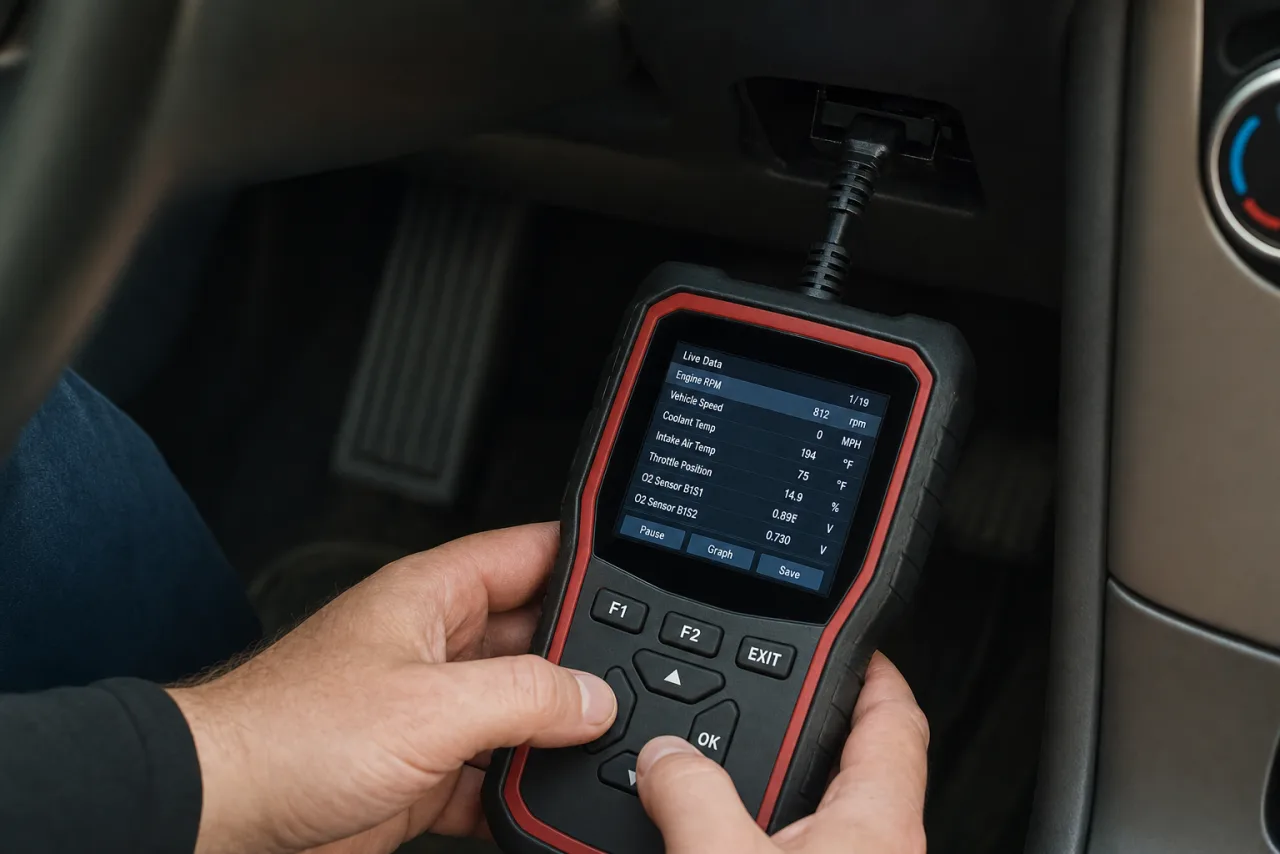
- Plug in an OBD2 scanner and read live data, not just codes. Look at DPF soot load percentage, ash load, and the differential pressure reading. High ash load (over 60 to 70 percent) means the filter is near end of life even if there are no codes yet. Our OBD2 scanner guide covers exactly which cheap adapters read this.
- Check regen history and how many miles since last regen. Very frequent regens point to a bigger problem.
- Ask how the car was driven. A city-only commuter diesel is a red flag. Highway miles are actually good for a DPF.
- Watch for a cleared check engine light. If emissions readiness monitors are all “not ready,” someone may have just reset codes to hide a DPF problem.
A pre-purchase inspection app like MotoPPI walks you through this OBD read and the rest of the checklist, so you can catch a $2,000 DPF problem before you hand over cash. It is a lot cheaper to skip the car than to fix the filter. For the bigger picture on whether a diesel is even the right choice, see gas, diesel, hybrid, or electric.
The bottom line
A DPF is a wear part that hates short trips. If you drive mostly in town, a diesel may not be the right car for you, and a clogged filter is close to inevitable. If you already have one showing the DPF light, try a highway regen run first before spending money. And if you are buying used, an OBD read of the actual soot and ash load tells you more than the seller ever will.
Quick FAQ
Can I drive with the DPF light on? Briefly, yes, to complete a regen run. If the car is in limp mode, get it looked at before you cause more damage.
Does a DPF cleaning work as well as a new one? If the filter isn’t cracked or melted, a proper machine clean restores most of the original performance for a fraction of the cost.
How long should a DPF last? Roughly 100,000 to 150,000 miles with good highway driving and correct oil, less if the car lives in the city.