The check engine light is the most misunderstood warning on your dashboard. For some people it triggers instant panic and a $150 diagnostic fee. For others it becomes wallpaper they ignore for two years until something expensive breaks. Neither reaction is right. The check engine light (CEL, also called the malfunction indicator lamp or MIL) is just the car’s way of saying “I stored a fault code, come look.” What matters is which code, and whether the light is steady or flashing.
The good news is that in a few minutes with a $20 tool you can find out exactly what your car is complaining about, and often decide for yourself whether it is a cheap fix or a real problem.
Steady light vs flashing light
This is the single most important distinction, so learn it first.
- Steady (solid) check engine light: the car detected a fault but it is not causing immediate damage. You can usually keep driving and get it diagnosed soon. Treat it as “this week,” not “this second.”
- Flashing check engine light: this means an active engine misfire that is dumping raw fuel into the exhaust and can destroy your catalytic converter (a $1,000 to $2,500 part). Ease off the throttle, reduce load, and get to a shop or home. Do not keep driving hard on a flashing light.
If a red oil-pressure or temperature light comes on alongside the check engine light, stop and shut the engine off. Those are different, more urgent warnings.
How OBD2 diagnosis works
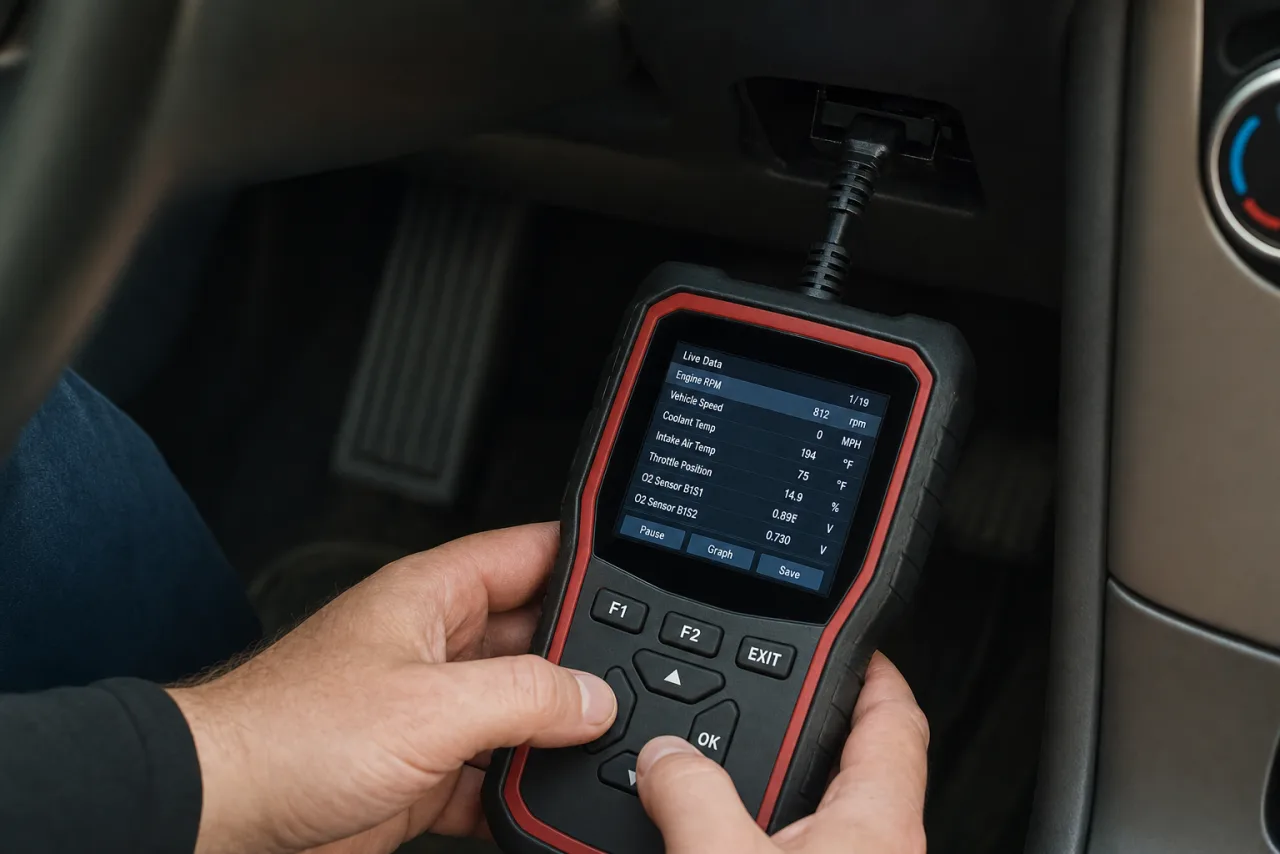
Every car sold in the US since 1996 has an OBD2 port, usually under the dash to the left of the steering column. When the engine computer detects something out of spec, it stores a diagnostic trouble code (DTC) and often turns on the light. An OBD2 scanner reads that code so you know where to look.
Codes look like P0300 or P0420. The first letter and number tell you the system (P0 = generic powertrain), and the rest points at the specific fault. Reading them is the difference between guessing and knowing. You can buy a cheap Bluetooth ELM327 adapter and a phone app for around $15 to $30, and it will read and clear codes and show live data. Our OBD2 scanner guide covers which adapters actually work and which apps to use.
Important: clearing the code does not fix the problem. If the fault is still present, the light comes back after a few drive cycles. Clearing codes only makes sense once you have fixed the underlying cause.
Common codes and what they cost
- P0420 / P0430 (catalyst efficiency below threshold). Often a lazy oxygen sensor ($200 to $400) rather than the catalytic converter itself. A converter replacement runs $1,000 to $2,500.
- P0300 and P030X (random or cylinder-specific misfire). Usually spark plugs or ignition coils. See spark plugs and ignition coils. Plugs are cheap, coils $50 to $150 each.
- P0171 / P0174 (system too lean). Often a vacuum leak or a dirty mass airflow sensor. Cleaning is nearly free; a MAF sensor is $100 to $300.
- P0455 / P0442 (evaporative leak). Very commonly a loose or bad gas cap, a $15 to $40 fix. Tighten the cap and the light may clear on its own.
- P0128 (coolant below thermostat regulating temperature). Usually a stuck-open thermostat, $150 to $350.
- P0401 / P0402 (EGR flow problem). See the EGR valve guide. Cleaning or replacement, $100 to $900.
So the same light can mean a $20 gas cap or a $2,000 converter. That is exactly why you read the code before you spend a dollar.
Is it safe to drive?
Use this quick rule of thumb:
- Flashing light: no, drive gently only to get somewhere safe.
- Steady light plus a noticeable symptom (rough running, loss of power, odd noise, smoke): drive minimally and diagnose promptly.
- Steady light, car feels totally normal: usually fine to keep driving short term, but read the code so you know what you are dealing with. Emissions faults can also cause you to fail a state inspection.
What it means when buying a used car
Here the check engine light plays a bigger role than most buyers realize, because sellers know how to hide it. A common trick is to clear the codes right before you show up so the light is off during your visit. The tell is in the OBD2 data: after codes are cleared, the emissions “readiness monitors” reset to “not ready” and take many miles to complete. If you plug in and see the light off but most monitors “not ready,” someone likely reset the computer recently. That is a red flag worth walking away over.
So on any used car, plug in an OBD2 scanner yourself and check for stored codes, pending codes, permanent codes, and readiness status. A permanent DTC cannot be cleared by a normal scanner, so it is a reliable sign of a real, recent fault the seller could not erase. A pre-purchase inspection app like MotoPPI walks you through exactly this scan as part of the checklist, alongside the paint, tires, and test drive. For the full walkthrough see how to inspect a used car.
The bottom line
The check engine light is information, not a death sentence. Learn the steady-versus-flashing rule, keep a cheap OBD2 adapter in the glovebox, and read the code before you panic or ignore it. On a car you own, that saves you from unnecessary shop fees. On a car you are about to buy, an OBD2 read is one of the cheapest ways to avoid inheriting someone else’s expensive problem.