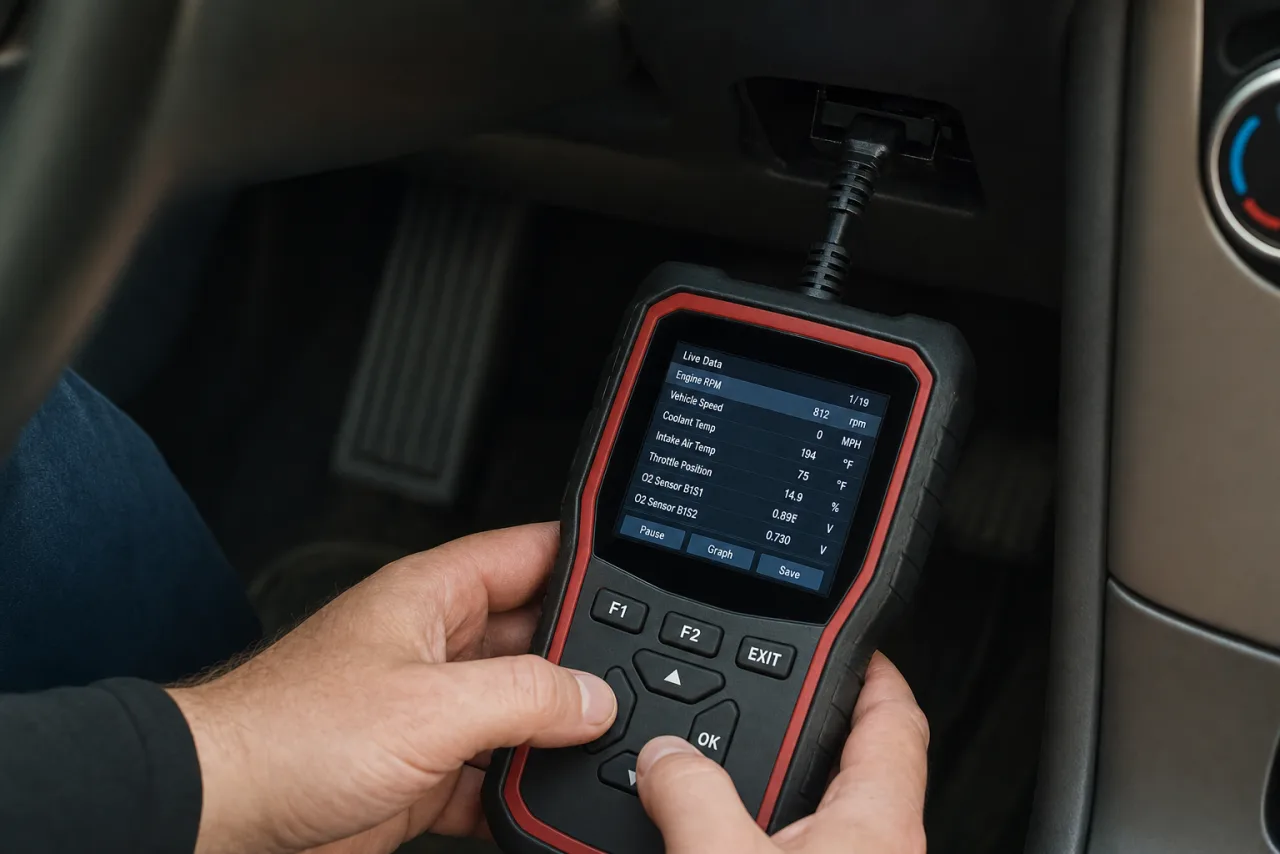
An illuminated check engine light used to mean a trip to the shop and a diagnostic fee just to be told what is wrong. Not anymore. The best OBD2 scanner for most people costs less than that single shop visit and pays for itself the first time it saves you a wasted appointment or, better yet, talks you out of buying a car with a hidden fault. Every car and light truck sold in the US since 1996 has an OBD2 port, usually under the dash near the driver’s knee. Plug in a scanner and the car tells you, in its own coded language, what is bothering it. This guide ranks the best OBD2 scanners on a budget and helps you match the tool to what you actually need.
The good news is that even a cheap scanner reads and clears the codes behind most check engine lights. You do not need a thousand-dollar dealer tool to be dangerous in a good way. What you pay more for is speed, extra systems like ABS and airbags, live sensor data, and manufacturer-specific codes. Here is how the tiers stack up.
Tier 1: Bluetooth dongles ($15 to $40)
The cheapest way in. A small adapter plugs into the OBD2 port and pairs with a phone app over Bluetooth. Pick a well-reviewed dongle and a decent app and you can read and clear generic codes, watch live data like coolant temperature and fuel trims, and check emissions readiness monitors before a smog test.
The catch: quality is all over the map, and the very cheapest clones can drain your battery if left plugged in, or fail to connect reliably. Buy one with strong reviews, and turn off the pass-through app permission that some cheap ones abuse. For a used-car buyer on a budget, a good dongle plus a phone is honestly all you need.
Tier 2: Handheld code readers ($40 to $100)
A dedicated handheld with its own screen. No phone, no pairing, just plug in and read. These are rugged, fast, and idiot-proof, which makes them great for anyone who wants a tool that simply works. Mid-range handhelds add live data graphing and freeze-frame info that shows what the engine was doing when a fault triggered.
This is the sweet spot for people who inspect cars regularly or dislike fiddling with apps. The trade-off versus a dongle is that the screen is small and you cannot easily save or share reports.
Tier 3: Advanced scanners ($100 to $300)
Now you get access beyond the engine: ABS, airbag (SRS), transmission, and sometimes TPMS and service resets. These read manufacturer-specific codes, not just generic ones, so they catch faults a basic reader misses entirely. If you work on your own cars or flip vehicles, this tier is worth it.
For a one-time private buyer, it is usually overkill. The extra systems matter most when you are actually diagnosing and fixing, not just screening a purchase.
Which tier is right for you
- Buying one used car: a Tier 1 Bluetooth dongle is plenty. You are screening for stored and pending codes and confirming the emissions monitors were not just reset to hide a light.
- Inspecting cars regularly or on a small budget: a Tier 2 handheld, for speed and reliability.
- DIY repairs or reselling cars: a Tier 3 advanced scanner, for the deeper system access.
Our deeper breakdown of features and models is in which OBD2 scanner to buy, and the full guide to using one is the OBD2 scanner guide.
What matters more than the scanner: how you use it
A scanner is only as good as the person reading it. Two things trip up beginners. First, a car with no stored codes is not automatically healthy - a seller can clear codes right before you arrive, which also resets the emissions readiness monitors. If those monitors show “not ready,” be suspicious, because it often means a light was just erased. Second, pending codes matter as much as stored ones; they flag a fault that is starting but has not triggered the light yet.
When you are checking a car to buy, the scan is one piece of a bigger picture. You also want the VIN history, a paint check for hidden bodywork, and a proper test drive. Doing all of that with separate tools is a hassle, which is why a pre-purchase inspection app like MotoPPI folds the OBD2 read into a single guided flow alongside the VIN check, the paint inspection, and the test-drive checklist. The scanner tells you the codes; the app tells you what to do with them.
The bottom line
The best OBD2 scanner on a budget is the cheapest one that does what you need, and for most used-car buyers that is a well-reviewed $20 to $40 Bluetooth dongle. Step up to a handheld if you value speed and simplicity, or to an advanced scanner if you actually repair cars. But do not confuse buying the tool with knowing how to read it. Pair any scanner with a structured inspection - see how to inspect a used car - and even the cheapest one becomes a genuine money-saver. And if the light is on when you plug in, do not ignore it; start with what the check engine light means before you assume the worst.