The EGR valve is one of those parts that exists purely to keep emissions in check, does its job invisibly for years, and then clogs solid with carbon and causes a string of annoying symptoms. It affects both gas and diesel engines, though diesels suffer worse because they produce more soot. When an EGR valve sticks or clogs, you get rough running, lost power, a check engine light, and sometimes limp mode. The fix ranges from a $20 can of cleaner to a $900 replacement.
Because a bad EGR also pumps extra soot downstream, it is closely tied to DPF problems on diesels, and the two often fail together. So it is worth knowing what this valve does and how to tell when it is on its way out.
What the EGR valve does
EGR stands for exhaust gas recirculation. The valve routes a small, controlled amount of exhaust gas back into the intake to be burned again. Recirculated exhaust is inert, so it lowers combustion temperature, and that cuts the formation of nitrogen oxides (NOx), a regulated pollutant. It is a clever, cheap way to reduce emissions.
The downside is built in: you are deliberately feeding sooty, oily exhaust back into the intake. Over tens of thousands of miles, that soot bakes into carbon deposits that coat the valve, the passages, and the intake manifold. Eventually the valve sticks. If it sticks open, too much exhaust dilutes the intake and the engine runs rough and gutless, especially at idle and low load. If it sticks closed, NOx and combustion temperatures rise, and on a diesel it can dump extra soot into the DPF.
Symptoms of a clogged or stuck EGR valve
- Rough idle, the engine stumbling or shaking at a stop.
- Hesitation and loss of power under acceleration, particularly low in the rev range.
- A check engine light with codes like P0401 (EGR flow insufficient), P0402 (flow excessive), or P0404 (range/performance).
- Increased fuel consumption.
- Stalling, especially at idle or when slowing to a stop.
- A knocking or pinging from raised combustion temperature (stuck closed).
- Black smoke on diesels, and more soot reaching the DPF, which then clogs faster.
- Failed emissions test because NOx is out of spec.
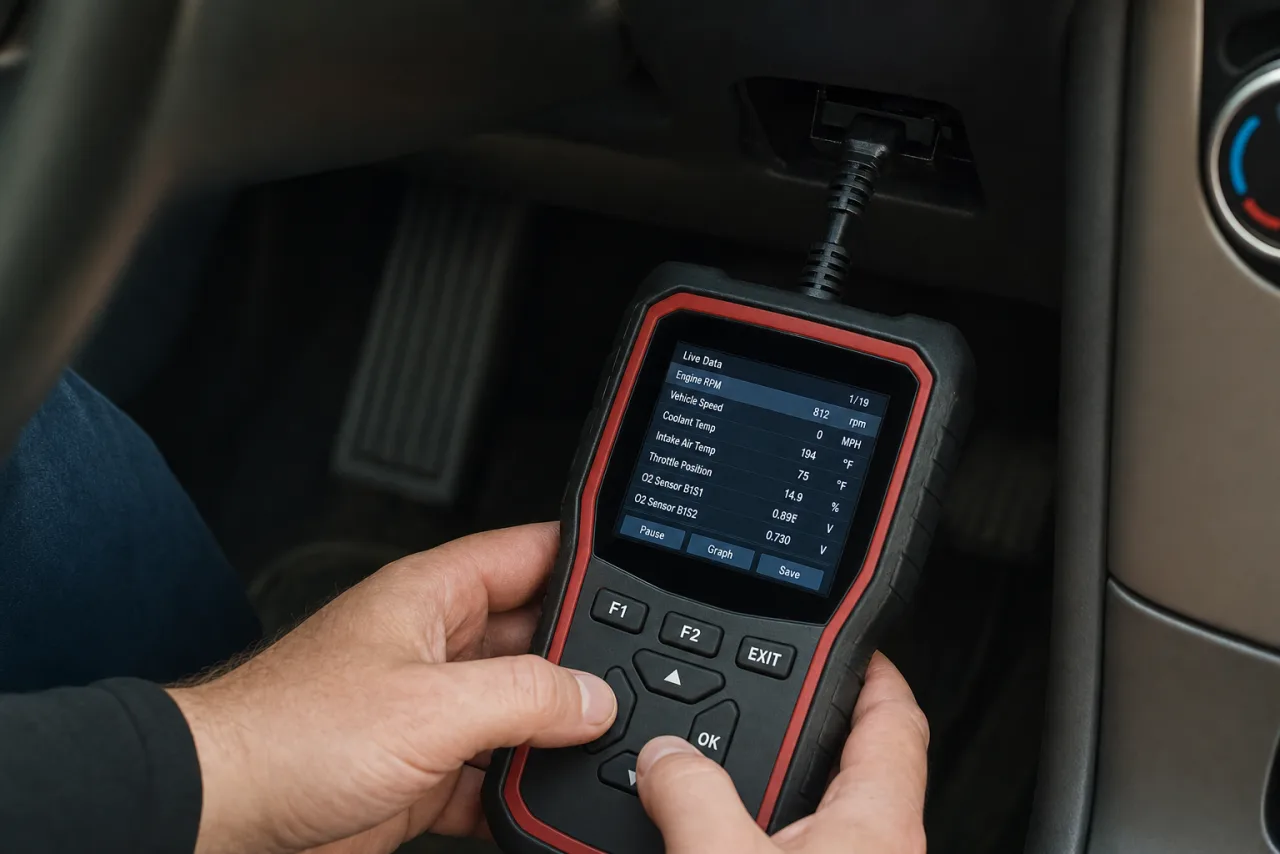
Because these symptoms overlap with dirty injectors, a bad MAF sensor, and DPF issues, reading the codes with an OBD2 scanner is the fastest way to point at the EGR. Our OBD2 scanner guide shows how, and the check engine light guide covers what the codes mean.
Clean vs replace
This is the real decision, and it depends on how far gone the valve is.
Cleaning makes sense when the valve mechanism is still good but simply carboned up. Many EGR valves can be removed and cleaned with carburetor or EGR-specific cleaner and a brush, clearing the soot from the valve and ports. If the valve is electronically actuated and mechanically sound, cleaning can restore normal operation.
- DIY cleaning: roughly $15 to $40 for cleaner, plus your time. Very doable on many engines.
- Professional cleaning: $100 to $250 including labor.
- Some shops offer an intake/EGR carbon cleaning service (walnut blasting or chemical) for $200 to $500 if the whole intake is coked.
Replacement is the answer when the valve is electrically dead, the actuator motor has failed, or it is so worn it won’t seal even after cleaning.
- EGR valve part: $150 to $600 depending on the vehicle, more for complex diesel units with a cooler.
- Replacement installed: $300 to $900, higher if the EGR cooler also needs replacing (common on some diesels and itself a $500 to $1,200 job).
Rule of thumb: try cleaning first on a valve that is mechanically fine and only throwing flow codes. Replace when the electronics are gone or cleaning doesn’t hold.
What it means when buying a used car
A sticking EGR is easy to miss because a warm engine on a gentle drive may not stumble much. It also travels with more expensive problems, so treat it as a clue:
- Plug in an OBD2 scanner and check for EGR flow codes, pending codes, and permanent codes the seller couldn’t clear.
- Watch idle quality at a cold start and after the engine warms. A persistent stumble or stall is suspicious.
- On a diesel, connect EGR symptoms to the DPF. A clogged EGR often means a soot-loaded DPF too, and that is a much bigger bill. Read the clogged DPF guide and check DPF soot load on the scanner.
- Check emissions readiness. If the EGR monitor is “not ready,” codes may have been cleared recently to hide a fault.
A pre-purchase inspection app like MotoPPI includes the OBD2 read that surfaces these flow codes, so a stumbling engine and a hidden soot problem show up before you buy rather than after. For the whole process, see how to inspect a used car.
The bottom line
The EGR valve is a cheap-to-cheap-ish part that causes outsized annoyance when it clogs, and on diesels it is a warning sign for the pricier DPF sitting downstream. If your own car has a flow code and a rough idle, cleaning is a sensible and inexpensive first move. If you are buying, an OBD2 scan that flags EGR and DPF trouble together is exactly the kind of thing that should shape your offer, or send you looking at the next car.