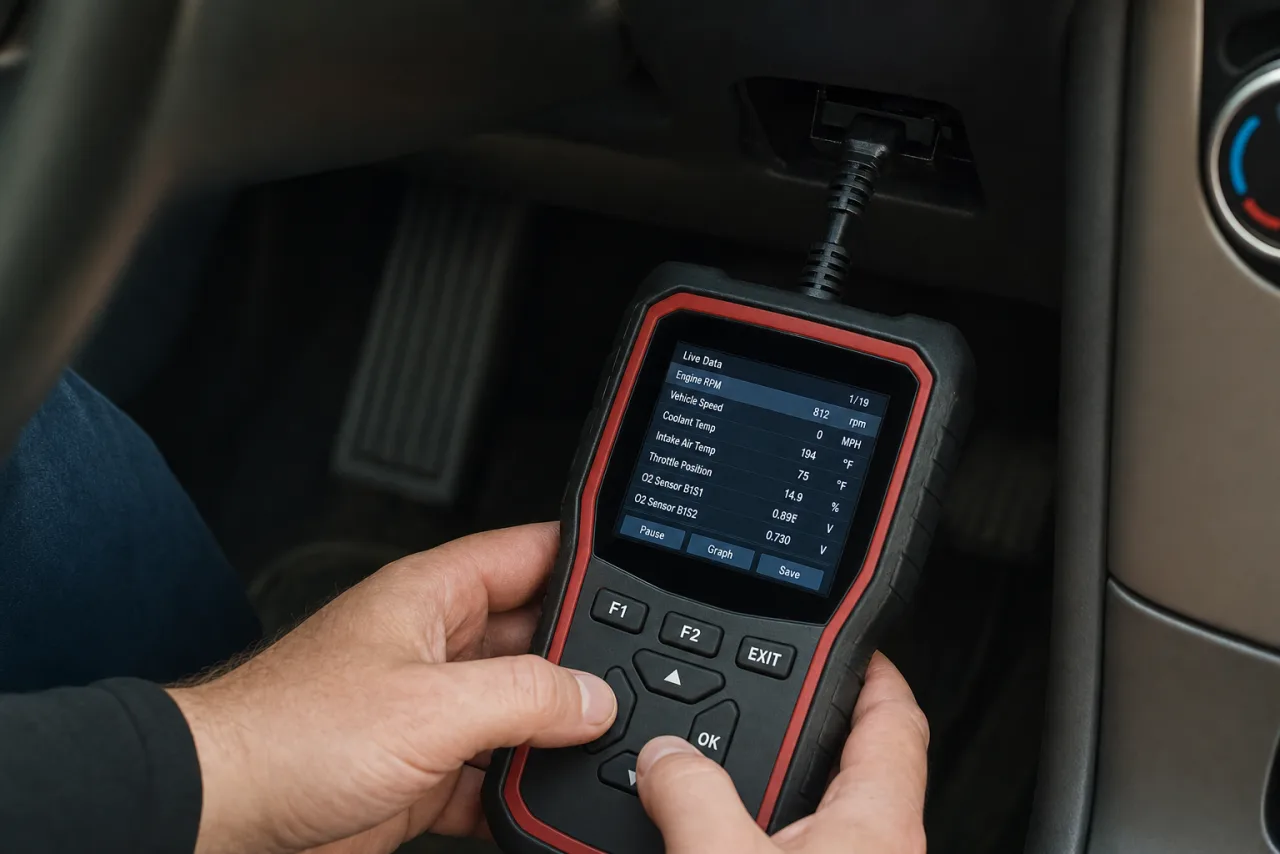
Spark plugs and ignition coils are what actually light the fire in a gas engine, and when they start to fail you get the unmistakable symptoms of a misfire: rough running, a stumbling idle, lost power, and a flashing check engine light. The good news is that these are among the cheaper and more DIY-friendly parts on the car, and diagnosing exactly which one is bad is often straightforward with a cheap OBD2 scanner. The bad news is that a neglected misfire can damage your catalytic converter, which is not cheap at all.
Here is how the ignition side works, what the symptoms mean, and how to figure out whether you need plugs, coils, or both.
How ignition works (gas engines)
In a gas engine, each cylinder needs a spark at exactly the right moment to ignite the fuel-air mix. The ignition coil transforms your 12-volt electrical system into the tens of thousands of volts needed to jump the gap on the spark plug. Most modern cars use coil-on-plug, meaning one coil sits directly on top of each spark plug. Older cars may use a single coil pack feeding several plugs through wires.
Spark plugs are wear items. The electrode gap erodes over time, requiring more voltage to fire until eventually the spark gets weak or intermittent. Ignition coils don’t have a fixed interval but fail with age and heat, often one at a time.
Symptoms of bad plugs or coils
- Engine misfire: a stumble, shake, or hesitation, worst at idle or under load. This is the hallmark symptom.
- Rough idle, the engine shaking or nearly stalling at a stop.
- Loss of power and hesitation on acceleration.
- Hard starting or the engine cranking longer before it fires.
- Increased fuel consumption, because unburned fuel is wasted.
- A flashing check engine light. This specifically warns of an active misfire dumping raw fuel into the exhaust, which can overheat and destroy the catalytic converter (a $1,000 to $2,500 part). Ease off and get it fixed; see our check engine light guide.
Diagnosing which one is bad
This is where a cheap OBD2 scanner earns its keep. Misfire codes are cylinder-specific:
- P0300 = random/multiple misfire (often plugs across the board, a vacuum leak, or fuel issue).
- P0301, P0302, P0303… = misfire on cylinder 1, 2, 3, and so on.
So if you see P0303, cylinder 3 is misfiring. The classic test: swap the suspect coil to a different cylinder and clear the code. If the misfire follows the coil to the new cylinder (say the code becomes P0302), the coil is bad. If the misfire stays on cylinder 3, the problem is the plug, the injector, or something mechanical in that cylinder. This swap test isolates the fault for the price of a few minutes’ work.
Our OBD2 scanner guide covers exactly which inexpensive adapters read live misfire counts, which are handy for catching an intermittent misfire before it sets a code.
When to replace, and cost (USD)
Spark plugs have intervals that depend on the plug material:
- Copper plugs: 30,000 to 50,000 miles (older cars).
- Platinum plugs: 60,000 to 100,000 miles.
- Iridium plugs: 80,000 to 120,000 miles (most modern cars).
Use the type and gap your manufacturer specifies. Replacing all plugs at once is standard practice.
- Spark plug replacement: $100 to $300 for a set including labor. The plugs themselves are $4 to $20 each; labor varies a lot depending on how buried they are (some V6 engines require removing the intake to reach the rear bank).
- Ignition coil: $50 to $150 each part, and $100 to $300 installed per coil. Many people replace the plug under a failed coil at the same time.
DIY is very approachable on cars with easy-to-reach plugs and coil-on-plug design, often turning a $250 shop job into a $60 parts job.
What it means when buying a used car
A misfire is easy to hide on a short warm-engine drive but shows up under scrutiny:
- Plug in an OBD2 scanner and check for stored and pending misfire codes and, if possible, live misfire counts per cylinder. Pending codes reveal an intermittent misfire that hasn’t lit the dash yet.
- Feel the idle at a cold start and after warm-up. A persistent shake or stumble is suspicious.
- Watch for a flashing check engine light on the test drive, and note if the light was recently cleared (readiness monitors “not ready” is a tell).
- Check service records for recent plug/coil work, which is normal maintenance, not a red flag.
A pre-purchase inspection app like MotoPPI runs the OBD2 scan and prompts you to assess idle quality, so a hidden misfire, and the catalytic-converter risk it carries, gets caught before you buy. See how to inspect a used car.
The bottom line
Spark plugs and coils are cheap, DIY-friendly parts that cause outsized symptoms when they wear, and an OBD2 scanner makes pinpointing the bad cylinder easy. Don’t ignore a misfire, because a flashing light means you are risking a converter worth many times the cost of a coil. On your own car, keep plugs to the manufacturer’s interval; on a used car, a quick OBD2 scan for misfire codes tells you whether the engine is running clean or hiding a stumble.