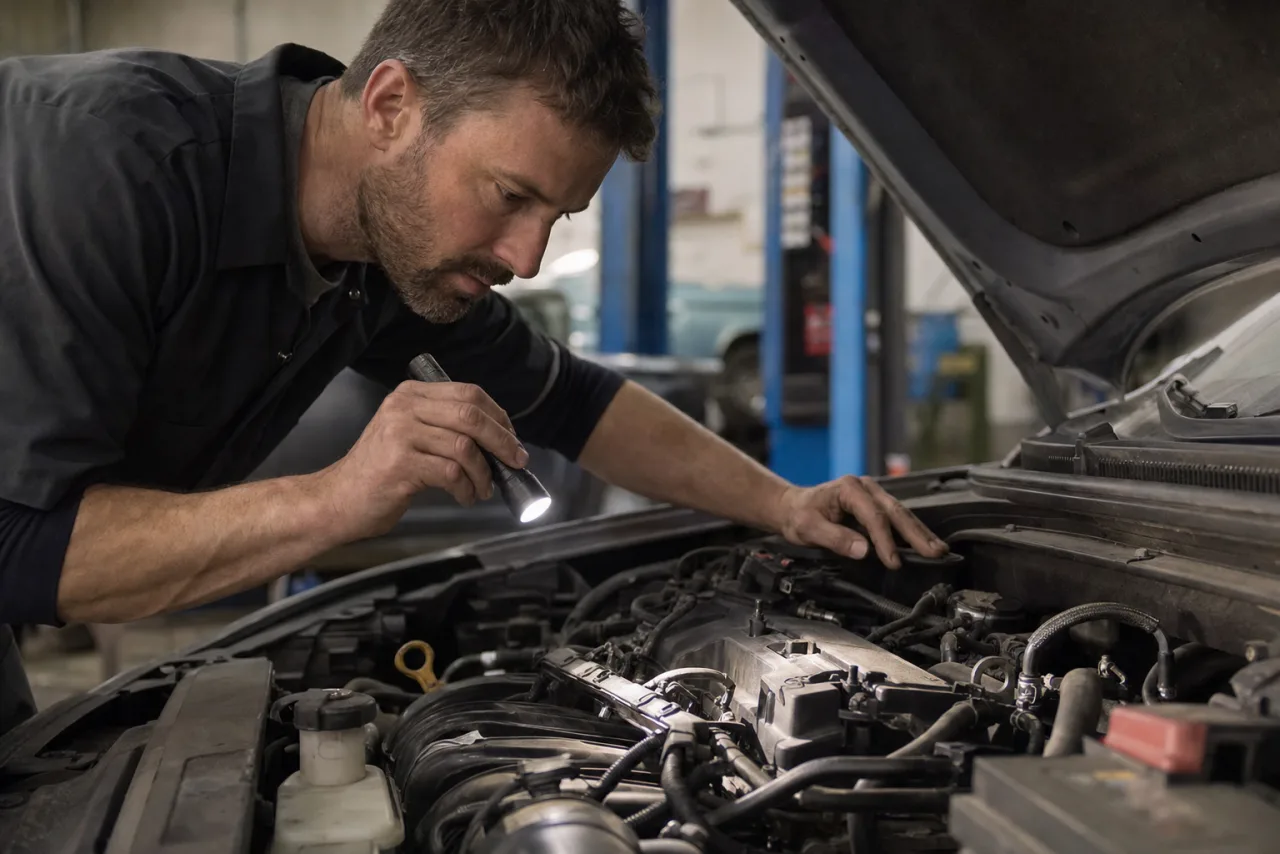
The thermostat is one of the cheapest parts in your engine and one of the most capable of causing expensive damage when it fails. A bad thermostat is a small valve that controls coolant flow, and when it sticks in the wrong position it can either let your engine overheat and warp the cylinder head, or keep it running cold and killing your fuel economy. Either way, the part itself costs $15 to $50, but the consequences of ignoring the symptoms can run into thousands.
The good news is that a failing thermostat gives clear warning signs if you know what to watch for, and catching it early turns a catastrophe into a quick, affordable fix. This guide covers bad thermostat symptoms, why they happen, what replacement costs, and what to look for when buying a used car with a questionable cooling system.
What the thermostat does
The thermostat sits between the engine and the radiator. When you start a cold engine, it stays closed so the coolant stays in the engine and the engine warms up quickly to its ideal operating temperature. Once the coolant reaches a set temperature (typically around 195 degrees Fahrenheit on most engines), the thermostat opens and lets coolant flow to the radiator to shed heat. It is a simple wax-and-spring valve that opens and closes based on temperature, with no electronics on most cars.
That simplicity is why it is cheap, but it is also a single point of failure sitting right in the path of your engine’s cooling. When it stops moving correctly, the whole temperature regulation goes with it.
Symptoms of a bad thermostat
A bad thermostat usually fails in one of two ways, stuck closed or stuck open, and the symptoms depend on which:
- Overheating (stuck closed). If the thermostat sticks shut, coolant cannot reach the radiator and the engine temperature climbs fast, especially at idle or in traffic. The gauge rises toward the red and you may see steam or smell hot coolant. This is the dangerous failure.
- Engine runs too cold (stuck open). If it sticks open, coolant flows constantly and the engine never fully warms up. The temperature gauge sits below normal, the heater blows lukewarm, and the engine runs rich, hurting fuel economy.
- Temperature gauge swinging erratically up and down as the valve sticks intermittently.
- Poor heater performance in the cabin, or a check engine light for a coolant temperature that is out of range (a P0128 code is common for an engine that runs too cool).
- Coolant leaks around the thermostat housing, where the gasket or plastic housing can crack with age.
If your temperature gauge is climbing toward the red, treat it as an emergency and pull over, because a stuck-closed thermostat can quickly lead to serious damage. Our guide on the cooling system and overheating covers what to do the moment the gauge spikes.
Why the overheating risk is so serious
An engine that overheats is not a slow problem. Excessive heat can warp the aluminum cylinder head, blow the head gasket, and in the worst case cause the pistons to seize in the block. Those repairs range from roughly $1,000 to $2,500 for a head gasket to the cost of a whole new engine if it seizes. All of that from a valve that costs less than a tank of gas. That imbalance is exactly why the thermostat is a part you never ignore, and why a rising temperature gauge is never something to “watch for a few more days.”
Replacement cost
Replacing a thermostat is one of the more affordable cooling system repairs. The part itself runs $15 to $50 for most cars, sometimes more if it comes as a housing assembly with a built-in sensor. Labor depends heavily on how buried the thermostat is: on some engines it is right on top and takes 30 minutes, while on others it is tucked under the intake or timing cover and takes hours. Expect a total of roughly $150 to $300 at a shop for an accessible thermostat, and $300 to $500 or more if it is hard to reach or comes as a full housing.
Because the coolant has to be drained and refilled, many people replace the thermostat at the same time as a coolant change; see our guide on when to change coolant and which type to use.
What this means when buying a used car
A car with cooling problems is one you want to catch before you buy, because an engine that has been overheated may have hidden head gasket or warpage damage. When inspecting a used car:
- Watch the temperature gauge on a test drive. It should climb to normal and stay steady, not run cold or creep toward the red.
- Check that the heater blows hot once warmed up; a lukewarm heater can point to a stuck-open thermostat or low coolant.
- Look for coolant leaks or crusty residue around the thermostat housing and hoses.
- Scan for stored codes like a coolant temperature fault; a hidden check engine light is a warning.
This is where a phone-based check earns its keep. The MotoPPI app lets you run an OBD scan for cooling and temperature codes, watch live engine data, and work through a body and fluid checklist, so a car with a marginal cooling system does not become your $2,000 problem a month later. For the full routine, see how to inspect a used car.
A bad thermostat is a cheap fix that turns into an expensive disaster only when it is ignored. Watch your temperature gauge, act the moment it climbs, and replace a suspect thermostat before it decides to stick shut on the highway.